
How should owners compare Airbnb and short-stay management services?
Updated: Oct 22
By Freedom2Host
Owners should compare Airbnb and short-stay management services by what is actually included, not by the label alone. Airbnb management may focus on one booking platform, while short-stay management can cover a wider operating role across listing channels, guest communication, changeovers, pricing and property upkeep.
In short: choose the service that matches how much of the property operation you want to hand over. Compare the written scope, fee structure, guest and cleaning arrangements, maintenance responsibility, owner access and contract terms before comparing headline prices.
Airbnb management and short-stay management: what is the difference?
Airbnb management usually means managing a property advertised on Airbnb. Depending on the provider, this may include creating or improving the listing, handling enquiries, managing bookings, communicating with guests and coordinating cleaning between stays.
Short-stay management is a broader description. It generally relates to the operation of furnished accommodation rented for shorter periods, whether bookings come through Airbnb, another booking platform, a direct enquiry or more than one channel. The exact scope still varies between providers, so the name should not be treated as a complete specification.
There is no automatic winner between the two. A property listed only on Airbnb may need a focused service. An owner who wants a wider operating arrangement may need support that also covers other channels, pricing decisions, maintenance and the practical running of the accommodation.
Why the labels can be misleading
Two businesses can use different service names but offer almost the same work. Equally, two businesses using the same label may provide very different levels of involvement. One may only manage messages and bookings, while another may also arrange linen, cleaning, inspections and repairs.
Ask for an itemised scope rather than assuming that “full management” means everything. The important question is not whether a provider uses the term Airbnb or short-stay; it is what happens before, during and after every booking.
What should owners compare?
1. Listing and booking management
Find out who prepares the listing, updates photographs and descriptions, responds to enquiries, manages booking requests and deals with cancellations or changes. If the provider uses more than one channel, ask how availability and pricing are kept consistent.
You should also establish who owns the listing accounts and content. This matters if you later change provider, decide to self-manage or want to retain access to booking history and guest information.
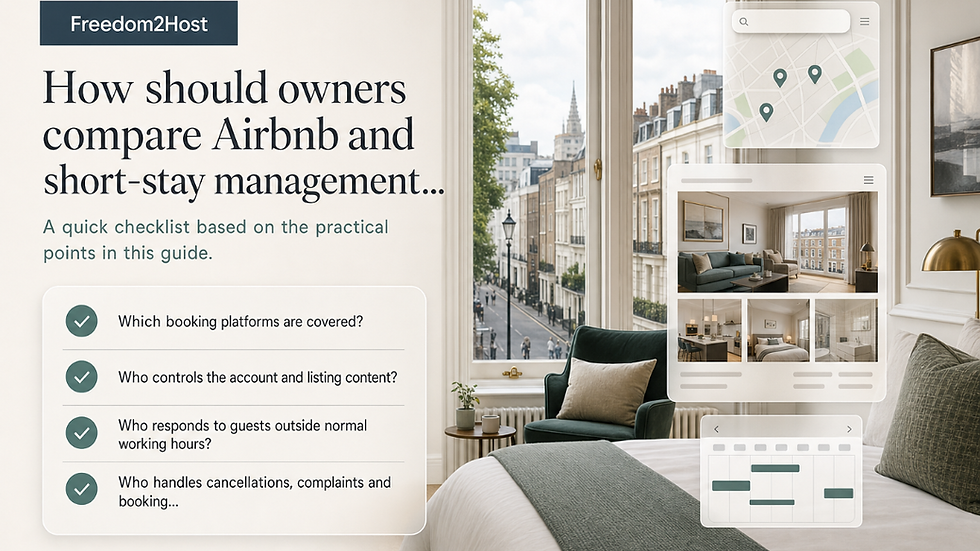
Which booking platforms are covered?
Who controls the account and listing content?
Who responds to guests outside normal working hours?
Who handles cancellations, complaints and booking changes?
How are duplicated bookings or calendar errors prevented?
A service restricted to Airbnb may be perfectly suitable if that is where you intend to take bookings. If you want to consider other channels or direct bookings later, ask whether the arrangement can accommodate that without creating extra administration or unclear fees.
2. Pricing and revenue decisions
Short-stay income can change with demand, season, local events, property condition, available dates and the quality of the listing. Ask whether pricing is reviewed as part of the service, who approves changes and whether any pricing tool or method is used.

Do not judge a management service on an implied income figure unless the assumptions are clear. Ask what occupancy, nightly rate, cleaning charges, platform fees, maintenance and management fees have been included, and whether the estimate is a forecast rather than a promise.
The cheapest management fee may not produce the lowest overall cost if important work is excluded or charged separately. Conversely, a wider service may not be worthwhile if you are comfortable handling guest communication, cleaning coordination or minor issues yourself.
3. Cleaning, linen and changeovers
Cleaning is not just a general housekeeping item. It is part of the changeover between one guest and the next, and it can affect reviews, arrival readiness and the condition in which problems are found.
Ask who arranges cleaning, whether linen and consumables are included, who checks the property after a guest leaves and how problems are reported. Clarify whether cleaning is paid by the owner, charged to the guest, deducted from income or billed separately.
Also ask what happens if a cleaner finds damage, missing items or a maintenance issue. A useful arrangement should make responsibility clear without leaving the owner to coordinate several separate people at short notice.
4. Maintenance and property care
A short-stay property receives regular use from people who do not own it. Small issues such as a failed appliance, damaged furnishing, blocked drain or missing key can quickly affect a booking if nobody is responsible for spotting and escalating them.
Compare what the provider does with maintenance. Some services may identify issues and pass them to the owner; others may help arrange trades or oversee practical property care. Neither approach is automatically better, but the limit should be written down.
Who is the first contact when something breaks?
Can the provider arrange an approved contractor, or only report the issue?
Is there an owner approval limit for repairs?
How are emergency decisions handled when the owner is unavailable?
Are routine checks, consumables or small replacements included?
Freedom2Host describes its published service scope as including listing management, guest communication, cleaning, linen, dynamic pricing and maintenance. That gives an owner useful areas to discuss, but the precise inclusions, exclusions and charges should still be confirmed for the individual property.
5. Guest communication and problem handling
Guest communication includes more than sending arrival instructions. Guests may ask about access, parking, appliances, local arrangements, noise, damage or changes to their booking. The provider should explain who deals with these questions and how issues are escalated.

Ask whether the service covers the full guest journey or only messages received through a particular platform. It is also worth asking how complaints, late arrivals, lockouts and alleged damage are recorded and communicated to you.
If you want to remain involved, agree what you will handle yourself. A clear division of responsibility is better than assuming that a management service will automatically deal with every guest-related problem.
6. Owner control and access
Management is a delegation decision, not simply a purchasing decision. Consider how much control you want over prices, minimum stays, blocked dates, guest criteria, furnishing choices and repair approvals.
Some owners want the property run with minimal involvement. Others want to approve important bookings, review costs or keep certain dates available for personal use. Ask how owner stays, calendar blocks and changes to the operating plan are managed.
Also check how often you receive statements or updates, what information is available about bookings and costs, and whether you can see the listing and calendar directly. These details affect how easy it is to check that the service is operating as agreed.
How do management fees affect the comparison?
There is no useful single “normal” price without knowing the property, service scope and fee structure. Providers may charge a percentage of booking income, a fixed amount, separate charges for specific tasks or a combination of these.
Compare the total arrangement rather than one percentage. A lower management fee may sit alongside separate charges for cleaning coordination, maintenance administration, guest call-outs, listing work or supplies. A higher fee may include more work, but only if those inclusions are confirmed.
Questions to put beside every quote
Is the fee based on gross booking revenue or money left after other deductions?
Are platform charges, payment fees and taxes treated separately?
Who receives cleaning or other guest-paid charges?
Are maintenance visits, contractor coordination or replacement items extra?
Are there setup fees, minimum terms or charges when the property is unavailable?
What happens if a booking is cancelled, refunded or disputed?
Use the same example property and the same assumptions when comparing providers. Ask each one to show what the owner would receive after the listed deductions. This will not predict future income, but it can expose differences in how the service is priced.
What practical and legal checks should owners make?
Before choosing a manager, check that short stays are suitable for the property. The relevant issues can include planning requirements, lease or freeholder restrictions, mortgage conditions, insurance, fire safety, gas and electrical responsibilities, waste arrangements and any local rules that apply.

A management company can help operate a property, but that does not automatically transfer every legal or ownership responsibility. Ask what checks the provider expects the owner to complete and whether any part of compliance support is included or excluded.
Leasehold owners should pay particular attention to building rules, nuisance provisions, access arrangements and restrictions on short-term occupation. A service can be operationally well organised but still unsuitable if the building or finance terms do not permit the intended use.
If the property is in a block, the relationship between guest access, neighbours, communal areas and building management becomes especially important. The guide on short-stay management in a serviced apartment block is relevant when those building-level concerns form part of the decision.
If this is the stage you are working through, you can also use Warning Signs Your Short-Stay Property Needs Better Management Support for the next practical checks.
Which service is likely to suit your situation?
Airbnb management may suit you when:
Airbnb is your main or only intended booking channel.
You want help with listing administration and guest messages.
You can arrange cleaning, linen or repairs yourself.
You want to retain responsibility for wider property decisions.
The property and its building rules are already suitable for short stays.
Broader short-stay management may suit you when:
You want one service to cover several parts of the guest and property operation.
You need support with cleaning, linen, pricing and maintenance as well as bookings.
You do not live close enough to handle practical issues reliably.
You want to discuss more than one booking channel.
You prefer a clearly defined operating arrangement rather than coordinating several suppliers.
These are not fixed categories. A smaller, focused service can be the sensible choice for an involved owner, while a wider arrangement can be more appropriate when availability, distance or day-to-day responsibilities make self-management difficult.
A sensible way to compare providers
Start by writing down what you will manage personally and what you need someone else to handle. Include guest messages, bookings, pricing, cleaning, linen, maintenance, supplies, compliance checks and owner reporting.
Define the property and booking plan. Note the type of accommodation, intended booking channel, owner-use dates and any known lease, mortgage or insurance restrictions.
Request an itemised scope. Ask each provider to mark what is included, excluded, charged separately or dependent on owner approval.
Compare the money flow. Use the same assumptions and list every deduction rather than comparing headline percentages.
Test the practical arrangements. Ask who handles a cleaning problem, guest complaint, damaged item, repair or access issue.
Check control and exit terms. Confirm account access, notice periods, listing ownership, owner stays and what happens when the arrangement ends.
Before committing, ask for the proposed terms in writing. If an important answer is only given verbally, it may be difficult to rely on later when a cost, responsibility or service boundary is disputed.
For owners who want one conversation about the wider operation rather than only listing administration, Freedom2Host’s short-stay management service covers the areas it publishes as relevant to running short-let accommodation, including guest communication, cleaning, linen, dynamic pricing and maintenance. Confirm the exact scope for your property before proceeding.
Want to compare the right level of support? Start with the property tasks you want covered and discuss the service scope, costs and responsibilities directly through the short-stay management service page.


Comments